 Cox & Kings' Latin America Product Manager Mark Crosby recently went on the trip of a lifetime to Antarctica. Here are his thoughts:
"If Antarctica were music it would be Mozart. Art, and it would be Michelangelo. Literature, and it would be Shakespeare. And yet it is something even greater; the only place on earth that is still as it should be. May we never tame it." Andrew Denton.
It’s hard to write a travelogue about a cruise to Antarctica without it sounding over-exaggerated. I could go on endlessly about how each day brought something different, each day there were surprises and each day threw up so many superlatives. So what I have tried to do instead is come up with a list of memories that I am sure will live with me forever. Sometimes they’re obvious, sometimes a little more personal. Please feel free to add your own comments and experiences to the list…or get down there yourself and make your own memories.
· Leaving Ushuaia down the lovely Beagle Channel. To port lies Argentina; to starboard, Chile. As the evening summer sun shines on green hills, we make introductions and enjoy dinner and wine as the signals disappear on the mobile. The real world will not exist for 10 nights.
 ·Trying to keep my eyes on the horizon in the infamous Drake Passage as the ship pitches and rolls slowly south, it feels like a roller coaster. Here the Atlantic and Pacific Oceans meet and a strong cold wind truly blasts the cobwebs away. I was concerned about being seasick but the worry disappears when a royal albatross flies so close to the ship I can touch her. The albatross follows, gliding behind and across the ship for hours and is a marvellous distraction from the endless ocean.
· A lecture on geology turning into a full-blown debate about the environment and whether tourists should go to Antarctica. One passenger declares that she would persuade people not to go to Antarctica, in order to preserve its pristine state. Another replies that you would probably do more damage to the continent everyday, just staying at home.
· Having a few beers listening to some of the crew play Chilean folks songs (with a few verses of the Beatles thrown in) and looking out of the window to see the sun shining on an iceberg. It’s 2 o’clock in the morning.
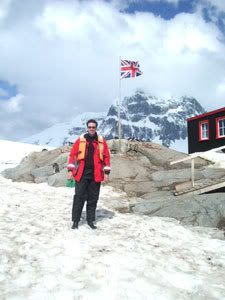
· Posting a few postcards home with Royal Mail stamps and paying in sterling at Port Lockroy. This is an old British base which has been restored to serve as a research station and museum. The union flag flies in a surreal location against beautiful white mountains and close to penguin and cormorant colonies. It was at this station that the research began which led to the discovery of the hole in the Ozone layer.
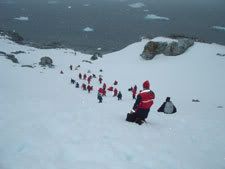
· Visiting an old whaling station is an eerie and fascinating reminder of the days of early exploration in the high latitudes. One of the crew has a football, so we manage a kick around on Antarctica - another unique day.
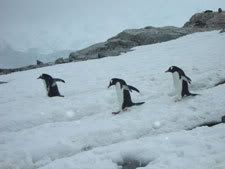
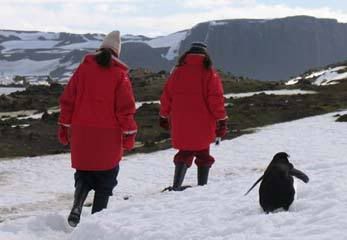
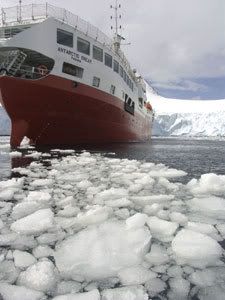 · Skirting the Antarctic Circle. The ice is too thick to proceed further, it is bitingly cold and the wind is high. It is here I realise a journey to Antarctica is not just a holiday, it’s a true adventure. Later in the season the guides say they will travel across the circle. We travel on land close to the circle where the snow is horizontal. I shelter on the rock and stared across the wilderness. Barely two feet away from me an Adelie penguin stops to take a look then continues its comical waddle toward the horizon.
 · Hearing fascinating lectures on geology and wildlife and also the history of exploration to Antarctica. Then going for tea on deck, looking out into the wilderness and marvelling at how those early explorers like Shackleton, Amundsen and Scott and their teams managed it and how they must have felt. It is not until you get there that you appreciate the immenseness of the unforgiving, and beautiful, wilderness.
"No person who has not spent a period of his life in those 'stark and sullen solitudes that sentinel the Pole' will understand fully what trees and flowers, sun-flecked turf and running streams mean to the soul of a man." Ernest Shackleton
· Swimming at Deception Island, a collapsed volcanic caldera into which ships can navigate, albeit with great care. The waters in the bay are hot springs, and on the shallow shore you can bathe in the waters. Swim just 3 metres from the edge however and it’s icy cold. At least it’s good to get a true appreciation of Antarctic waters, and is probably good for the skin or something.
· Heading north back up Drakes Passage at around 1 am and the sun is slowly setting, although in early December it never truly sets. As it sets in the West I can see the first glimmers of light coming up in the East, a bizarre experience.
· Getting back on dry land after a wonderful journey, with a satisfied smile on my face.
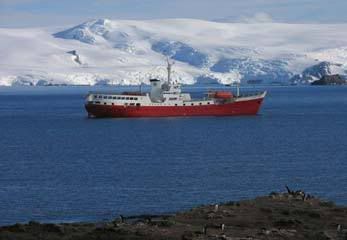
 I travelled on the Antarctic Dream, a new Chilean vessel specialising in cruises in Antarctica and Patagonia. What I enjoyed about this was that it was a small ship (maximum 96 passengers) so there was more room for flexibility with the itinerary (essential with the unpredictable weather conditions of Antarctica) and we were able to stay longer ashore than passengers on larger cruise ships. There is an excellent international crew but the majority are Chilean. I found this a nice touch especially as we departed from South America and we were able to eat Chilean food, drink Chilean wine and cocktails and one evening listen to Chilean and Spanish songs played on an old guitar by the ship's naturalist and the crew. The passengers were also a cosmopolitan mixture; from all over Europe, North and South America, South Africa and Australia as well as Britain so it led to interesting dinner conversations. I was impressed with the experience and assurance of the expedition team and lecturers. They were always helpful, always ready to share a story and we all trusted them completely to get the most out of this once in a lifetime experience. The guides are all also very attuned to the environmental impact of travelling to Antarctica and ‘green issues’ in general. They have a convincing argument that controlled tourism to the continent and the ability to pass on knowledge and enthusiasm will be more beneficial to the environment than closing it off completely. Then, not only scientists, but the whole world, will be able to see the fragility of the continent and its wildlife.
Mark Crosby